

I'm about to make a move into a new company, taking on another Principal Product Designer role. I've been operating at principal level for the past three years, so this isn't a new step up for me. But moving into a new organisation has given me an opportunity to reflect on what the role actually means, and more specifically, how I should approach it.
One thing I've been thinking about is where a principal designer should spend their time.
It's an interesting question because the role is often quite broad. You're expected to be strategic, deliver excellent design, influence product direction, mentor other designers, improve processes, contribute to design systems and generally make things better.
All reasonable expectations. But how do you balance them? And who decides where your energy is best spent?
I think we sometimes treat the principal role as a fixed collection of responsibilities, when in reality it should be much more fluid.
Moving into a new company makes that particularly obvious. The challenges, people, products and organisational maturity will be different. What worked in my previous role might not be what this organisation needs from me.
Rather than arrive with a predetermined idea of what my responsibilities should look like, I'd like to understand where I can make the greatest difference.
That thinking formed a shape in my mind, which coincidentally spelled POSE.
Introducing POSE
POSE stands for Product, Operations, Strategy and Execution.
It's built around two axes:
Product vs Operations: Are you focusing on the product experience or the organisation and systems that make product design possible?
Strategy vs Execution: Are you shaping direction and making decisions, or doing the work to bring those decisions to life?
Put those together and you get four quadrants:
| Strategy | Execution | |
|---|---|---|
| Product | Product Strategy | Product Execution |
| Operations | Operations Strategy | Operations Execution |
Each quadrant represents a different area of contribution for a Principal Product Designer.
Product Strategy
What should the product become, and why?
This is about having a point of view on the product. Its vision, roadmap, customer problems, opportunities, positioning and direction.
It doesn't necessarily mean owning the product strategy. That's often the responsibility of a Product Manager or Product Director. But a principal designer should have an informed opinion and be able to influence the decisions being made.
Are we solving the right problems? Are we investing in the right experiences? Are there opportunities we're overlooking?
Product Execution
How do we design and deliver the right experience?
This is probably the quadrant most people associate with product design. Designing features, solving complex interaction problems, prototyping, validating ideas, developing design systems, reviewing work and collaborating with engineering.
It's where ideas become experiences.
I don't think principal designers should ever become detached from this work. You need to understand the details, know when to get involved and be capable of producing excellent design yourself.
Operations Strategy
How should the design organisation work?
This is where things get interesting.
Think about the team structure, organisational capabilities, headcount planning, design lifecycle, tooling strategy and the relationship between design, product and engineering.
Should the team be organised around products or capabilities? Do we have the right people and skills? How should AI change the way we design? Are we using Figma, Claude or other tools in the right way?
Again, a principal designer might not own these decisions, but they should have a point of view.
Operations Execution
How do we make the design organisation work effectively?
This is about putting operational improvements into practice. Establishing processes, maintaining design system infrastructure, improving workflows, introducing tools, creating governance and removing friction from the way teams work.
It's one thing to decide that a team needs a better design lifecycle. It's another to make it happen.
These four areas are connected, but they represent quite different ways of contributing.
Strategy is about having an opinion
There's something I want to emphasise about the strategy quadrants.
When I talk about strategy, I'm not necessarily talking about writing strategy documents, running workshops or being the person who owns the roadmap.
I'm talking about having an opinion.
A principal designer should be able to look at a product and form a view on where it should go. They should be able to look at a design organisation and form a view on how it could operate more effectively.
They should be able to challenge assumptions, identify problems and make recommendations.
You don't need to own the decision to influence it.
In fact, I think this is one of the more important distinctions between a senior designer and someone operating at principal level. It's not simply that the problems become more complex. The scope of your thinking expands beyond the immediate design problem.
You're considering the bigger picture and how the different parts fit together.
Drawing the circle
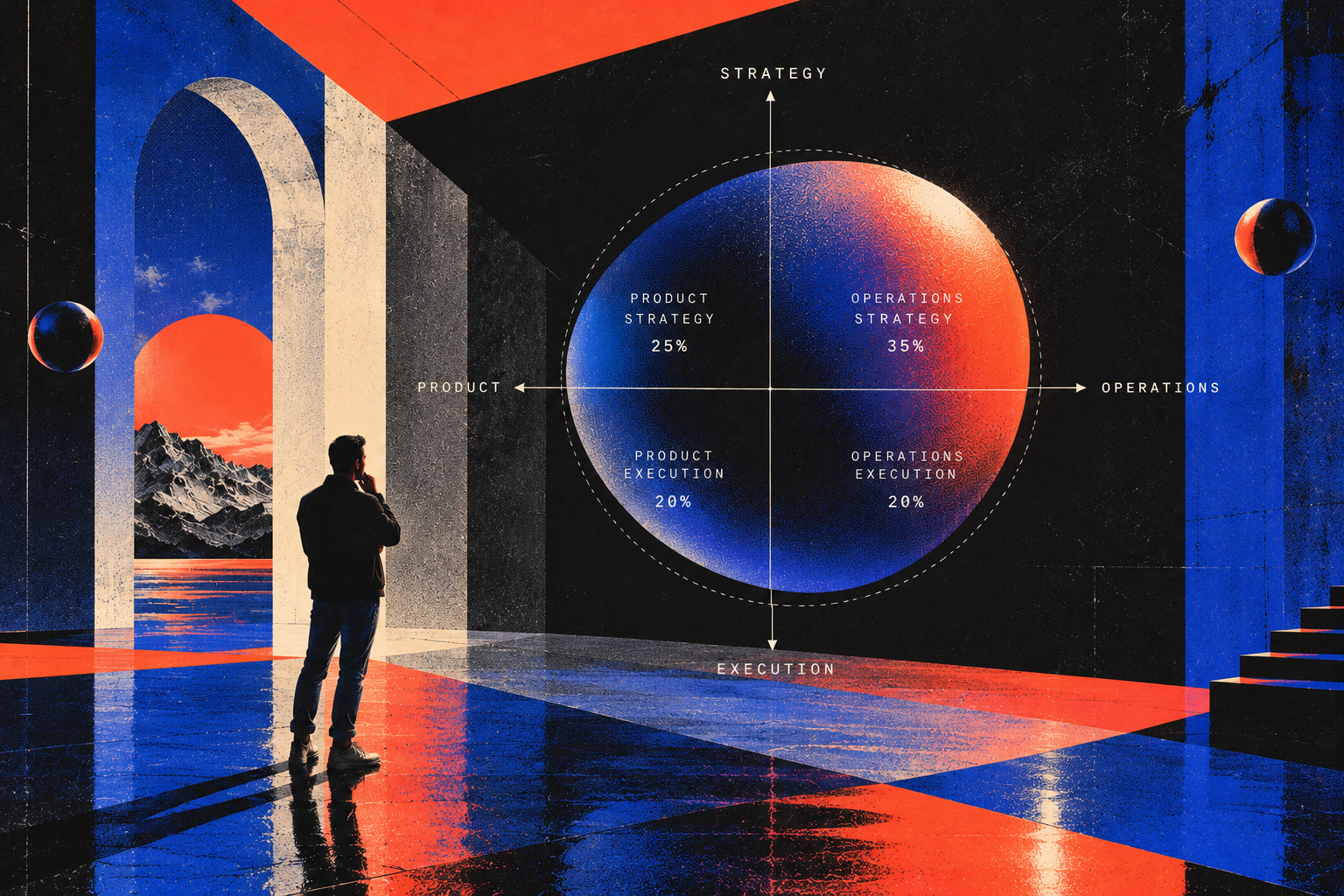
We see the challenge before us and allocate time appropriately to ensure we’re covering the four quadrants.
Here's where POSE becomes practical.
I imagine every principal designer having a circle drawn somewhere on the matrix. The circle represents how they're distributing their time and effort across the four quadrants.
Some designers might lean heavily towards Product Strategy and Product Execution. Others might spend more time improving the design organisation, focusing on Operations Strategy and Operations Execution.
Neither is inherently better.
The shape of the circle reflects the needs of the organisation, the responsibilities of the role and the areas where the designer can make the greatest contribution.
A principal designer working in a business preparing for a major product launch might spend most of their time in Product Execution. Another joining an organisation struggling with its design operating model might spend considerably more time in Operations Strategy.
The important thing is that the allocation is deliberate.
And it shouldn't be permanent.
Organisations change. Products evolve. Teams grow, shrink and restructure. Priorities shift. What matters most today might not be what matters six months from now.
The circle should move accordingly.
You might spend one quarter focused on improving the product experience, then shift towards operational improvements as the team scales. Later, you might find that the biggest opportunity is influencing the product's strategic direction.
I quite like the idea of thinking about this in seasons. A principal designer's role isn't necessarily static, and neither should their allocation of time be.
The matrix gives you a way to have that conversation with your manager. Where is the current gap? Where's the friction? What's causing the most pain? Where would my time be most valuable?
It's less about trying to do everything and more about understanding what needs doing most.
You build POSE throughout your career
I also think there's an interesting relationship between POSE and career progression.
We tend to think about career progression in terms of increasing complexity, responsibility and influence. But perhaps another way to look at it is the expansion of the areas in which a designer can contribute.
Consider a typical progression.
Junior / Senior: Product Execution
The focus is on learning the craft of product design. Understanding users, solving problems, designing experiences and working with engineering to deliver them.
The designer is developing the foundations of their practice.
Staff: Operations Execution
The perspective begins to expand beyond individual features and projects. The designer starts improving the systems and processes that enable other designers to work more effectively.
Design systems, tooling, workflows and reusable patterns become a bigger part of their contribution.
Lead: Product Strategy
The designer develops a stronger opinion about what the product should become. They influence roadmaps, challenge assumptions, identify opportunities and help shape product direction.
They're increasingly working upstream of execution.
Principal: Operations Strategy
The designer starts thinking about the organisation itself. How should the design function operate? Do we have the right capabilities? Are we structured correctly? How should our processes and tools evolve?
They're considering the conditions required for the organisation to produce great products.
I don't mean this as a rigid career ladder. A senior designer can absolutely have strategic opinions, and a principal designer should still be capable of excellent execution.
But I do think there's a natural expansion of perspective as you progress.
You move from designing products, to improving how products are designed, to influencing what products become, to shaping the organisation that makes all of this possible.
The circle gets bigger.
As designers progress, they develop the potential to contribute across more of the matrix. But that doesn't mean every principal designer should have the same circle, or that reaching a particular title automatically gives you expertise in all four quadrants.
The breadth of your contribution grows with experience and judgement. Where you actually focus depends on what the organisation needs.
Your first 90 days shouldn't start with a circle
This is where POSE becomes particularly relevant to how I intend to approach my first 90 days.
I don't want to arrive with my circle already drawn. I will draw it by listening, understanding the organisation and forming my own opinion about where I am needed and can add the most value.
My intention is to listen.
Listen to the design team. Listen to customers. Listen to product and engineering colleagues. Listen to leadership.
Understand what's working, what's broken, where people are frustrated and where they see opportunities.
I don't want to arrive with a predetermined idea of what my role should look like or where I should spend my time. I want to understand the organisation first.
Then I can start forming an opinion.
Perhaps the biggest problem is the product direction. Perhaps it's the design operating model. Perhaps the team is capable but held back by inefficient processes. Or perhaps the biggest opportunity is simply getting closer to the details of the product experience.
The point is that I won't know until I've listened and developed a better understanding of the environment.
POSE gives me a way to translate those observations into an intentional allocation of time.
I'd like to use it as part of an ongoing conversation with my manager. Agreeing where the biggest needs are, what I should focus on, what I should own and where I should influence rather than execute.
Then revisit it as the organisation changes.
It's also a useful way to challenge yourself. Are you spending too much time doing the work you're comfortable with? Are you neglecting an area where you could make a bigger difference? Are you being pulled into execution at the expense of more important strategic work?
Sometimes the answer will be that you need to change where you're spending your time. Sometimes the organisation needs to change to give you the space to do so.
A framework, not a job description
I don't think POSE is about defining a universal set of responsibilities for every Principal Product Designer.
Nor is it a competency framework. Craft, quality, creativity, technical knowledge and user centricity should be foundations of good design, regardless of which quadrant you're working in.
POSE is about something different.
It's a way of understanding the breadth of the principal role and making deliberate decisions about where to invest your time.
A principal designer should be capable of contributing across all four quadrants, but that doesn't mean they should spend equal amounts of time in each. The organisation's needs should determine where the emphasis sits.
And those needs will change.
Perhaps the most useful question isn't what a Principal Product Designer should be doing in general.
It's this:
Given where this organisation is today, where can I make the greatest difference?
That's where I'd start drawing the circle.